The Speedway Laboratory
It was raining the night I bought my first Star Wars action figure. I was four years old, running errands with my parents on a Friday night when Dad got paid. Dad’s beige Chevy truck had a camper shell, and my brother Alex and I stood with our arms resting on the vinyl boot that connected the truck bed to the cab. Rains washed the streets clean, and every traffic stop provided an opportunity to gaze at the brilliant streams of red, yellow, and green light reflecting off the asphalt.
We stopped at a store called Yellow Front, a once-popular discount chain that originated in Phoenix, Arizona. Towards the back of the store, an endcap featured a pegboard with rows of Star Wars action figures. We had seen the movie weeks earlier, and this display reintroduced us to a haunting world that we left at the theater. We rifled through the filled racks, and the sound of blister cards jostling on scan hooks became the soundtrack to our frantic search.
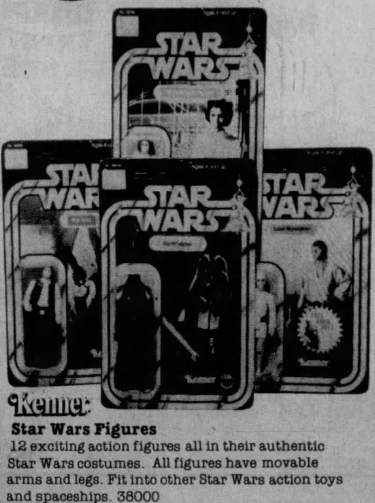
So many choices. Alex grabbed Han Solo. I reached for Snaggletooth. Unlike the Greedo and Darth Vader figures that Mom and Uncle Andy bought before, this was the first Star Wars figure I chose on my own. Until that moment, those characters were ghosts—flickering theater images in a galaxy far, far away. With that Yellow Front purchase, the myth finally had substance. For the first time, the story was something we could actually hold.
To avoid losing something, we weren’t allowed to open toys until we got home. After climbing into the back of Dad’s truck, I grabbed the carded Snaggletooth from the Yellow Front bag. As we drove home, waves of fluorescent orange light from the streetlights on Speedway entered and exited the tinted bubble window of the camper shell. With each new wave of light, the image of Snaggletooth on the blister card alternately emerged from and retreated into shadow. In the dim light of the camper, my brother and I studied every detail of our cards in complete silence—the only sounds coming from Mom and Dad talking in the cab, the slosh of cars driving in the rain, and the whir of shifting gears from the truck’s transmission.
Anchors in an Analog Void
The experience I just described is a microcosm of what made the Star Wars franchise so popular. Millions of kids experienced some version of my Yellow Front memory. The movies were great, but it was the connection kids formed with the films through merchandise that made Star Wars a phenomenon. Ironically, one factor that made these movies so iconic was the lack of access to them.
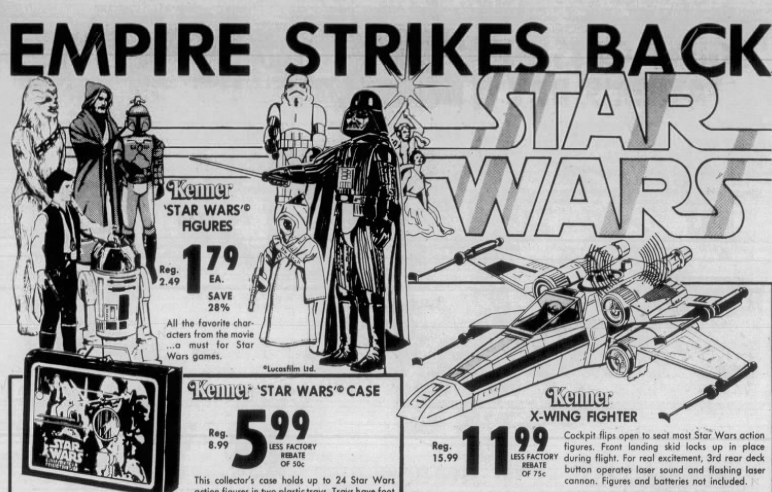
When each of the Star Wars films came out, your only chance to see it was in a theater. Once the film run ended, that was it. You couldn’t rent it at the local video store. You could’t stream it. From that point on, the movie wasn’t available. Merchandise provided fans a way to stay connected to the Star Wars universe. To keep the movie magic alive, kids convinced their parents to take them to Burger King and buy the commemorative Empire Strikes Back glass featuring Darth Vader and Boba Fett.
These and countless other merchandise items were more than toys to play with and memorabilia; they were anchors to a world we were desperate to maintain a connection with. Every time you packed your metal Star Wars lunch box or staged a battle with a snowspeeder and an Imperial Walker during a sleepover at your friend’s house, your connection to that universe materialized.
The Physical Archive
In this environment, stores like Toy World at El Con Mall in Tucson were the physical archives of the myth. They offered us a path back into the Star Wars universe through the medium of ink, paperboard, and molded plastic. The Star Wars section of Toy World was a front-row theater seat, offering glimpses of the people and places in this outer space world.
Kenner’s action figure packaging design played a significant role in keeping the heart of the Star Wars myth beating. Each blister card featured a black background, framed by chrome racing stripes that merged into a Star Wars logo at the top. The figure came encased in a plastic clamshell at the bottom left portion of the card, flanked by a background color that matched the title box. Snaggletooth, for example, had a yellow background. Han Solo, green. On the right side of the card was the most important element: A high gloss photo of the character from a scene in the film.
Kenner, the toy manufacturing company that secured the right to produce and sell Star Wars merchandise, was instrumental in building the Star Wars Universe. Kenner’s toy line and marketing propelled Star Wars from a movie to a phenomenon. Whether you liked a particular action figure or not, studying its blister card was standard procedure because even the “boring” characters allowed a peek into the Star Wars universe. It was the photo of Snaggletooth on the blister card that compelled me to buy him. The image of this boar-headed, red-jumpsuit-wearing creature sitting barside in the dimness of Mos Eisley Cantina gripped my imagination. I had to have this character.
Data vs. Substance
I knew nothing about Snaggletooth, aside from the fact that he was in the bar where Han Solo ended Greedo. That tether to the film was the only ‘data’ I had, and in the silence of an analog childhood, the substance of the toy was enough. My imagination did the rest.
Today, there’s no shortage of information on the Internet about Star Wars characters. If the movie came out today, I could easily find out more about any action figure I was interested in. The site fandom.com identifies Snaggletooth as a Snivvian, a species of mammalian humanoids with large nostrils, protruding jaws, and small tusks. His real name is Zutton, and he has a brother named Takeel. In addition to being an accomplished bounty hunter, Snaggletooth also moonlights as an artist.
It’s one thing to know information about a character, and quite another to form a connection with him/her. The blister card that I took home from Yellow Front that night in 1979 had no information on Snaggletooth other than his name. Still, the somatic associations I have with this figure seared a neural pathway in my brain that forged a lifelong bond with the character and the toy line: A rainy night, Yellow Front, an endcap with action figures, the photo of Snaggletooth in a dimly-lit cantina, and the matching yellow background and title box on the blister card—These are the building blocks of my childhood love of Star Wars.
The Anatomy of the Breach
Were it not for the physicality of the action figures, I never would have remembered this rainy night of shopping with my parents. Snaggletooth would be just another background character in the bar scene in Star Wars. Looking back, the actual purchase of each Star Wars figure was the highlight of my childhood memories with this toy line. The anticipation of running to the store’s toy section, locating the Star Wars collection, and immersing yourself in the sensory magic beats everything else—including playing with the toys.
I always felt bad ripping the blister card to get to the action figure. At home, we’d go straight to the dinner table and tear open the plastic clamshell. There was no good way to do this. A rookie tore indiscriminately, ruining the card completely. Someone with more patience, like me, used the file end of a nail clipper to carefully dig between the plastic and paperboard, to pry the clamshell off.
Even if you were careful, there was no foolproof way to extract the figure from the plastic chamber without tearing away critical bits of the hero image. The resulting “fuzz” of the torn paperboard is a somatic trigger for anyone who has ever ruined a cardback. And what were you to do with the card afterwards? It was no longer in pristine condition, and no matter how attached you were to it moments before, something of its magic was lost when the toy came out.
Even at my young age, tossing the opened card in the trash felt wrong. That’s because part of my connection to the film disappeared with the loss of the details. The action figures themselves were not the best-engineered toys; arms and legs didn’t bend, accessories were easily lost, and the detailing was minimal. There were other toy lines with better features, but Star Wars toys were always my favorite to collect.
The Amazon Void
Imagine if Star Wars premiered today. No need to dress in costume and wait in long theater lines. Why bother? Just stream it on your phone with Disney+. Like the movie? Want a Darth Vader action figure? Buy it on Amazon. It will arrive on your front porch tomorrow in the same white plastic bag as all your other Amazon orders. After tearing open the bag, you lay eyes on the figure for the first time in physical form against the backdrop of … your couch. The momentary dopamine hit fades, and you’re back online shopping for your next distraction.
This is why Star Wars would never be the blockbuster it is were it not for its release in the late 1970s. Special effects in films are dime-a-dozen nowadays, so Star Wars’ technical merits would be on par with every other modern film. The story is powerful, but its luster would fade quickly because digital movie consumption lacks ceremony. The merchandise would be much easier to access, but finding and acquiring it would take place online, making the experience generic and forgettable.
The St. Ambrose Sandbox
Friction was part of what made Star Wars, Star Wars. If the film had been easily accessible, people would have watched it repeatedly and quickly tired of it. On their own, the toys and merchandise would not have the “juice” necessary to sustain interest in the films. That’s because much of the world-building in George Lucas’ masterpiece occurred not on the film set, but in the Star Wars toy sections of stores throughout the world. Like me, the Mos Eisley Bar on Tatooine came to life on a rainy night in Tucson at Yellow Front.
Somewhere in a large plastic pumpkin at my mom’s house is my childhood collection of Star Wars figures. Snaggletooth is one of them. His once-black hair is faded and patchy thanks to years of wear. His red jumpsuit has paint scratches, and his laser blaster has been lost for years. Each of these deficiencies is the result of years of imaginative play. This figure was used as a prop in many staged movie scenes in my room. I snuck it to St. Ambrose school in my pocket to play in the sandbox during recess. When I got old enough, it was tossed in the plastic pumpkin as a keepsake of my childhood.
As an adult, there are many films that I enjoy watching more than Star Wars. My tastes have changed as I have matured. Still, I doubt there will ever be a film that draws me in as completely as Star Wars did. Many Gen X-ers would agree. A big part of the reason why is that beat-up, faded Snaggletooth figure sitting in a pumpkin bin. The physical connection to the Star Wars world that fans established through the merchandise created pathways in the brain that will never fade away.