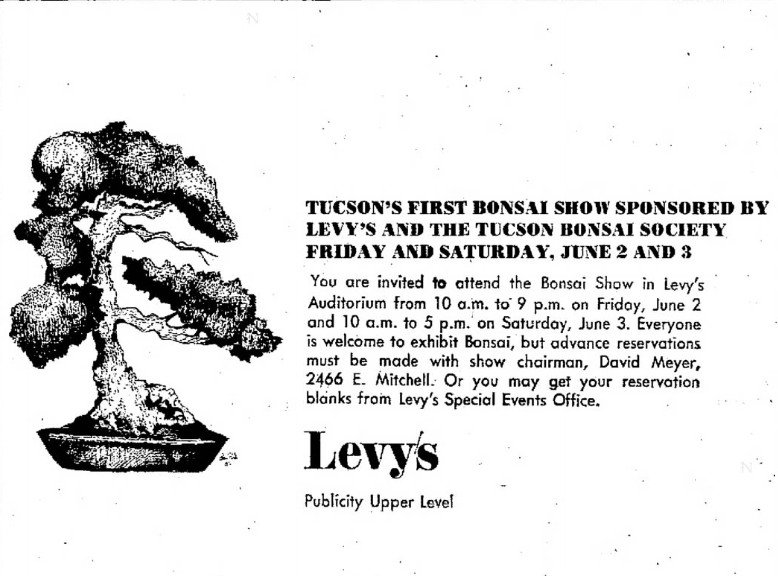
The Tucson Bonsai Society held its first sponsored show at Levy’s Fiesta Room in El Con Mall. The event, which featured tree displays as well as planting and pruning demonstrations, took place on June 2 and 3 in 1972.
Since its first show at El Con in 1972, the Tucson Bonsai Society has introduced many more Tucsonans to bonsai trees. Most would have no clue how much work went into each tree on display.
David Meyer, the late founder of the Tucson Bonsai Society, described bonsai as the creation of a living sculpture. “Creating a bonsai is not an overnight thing,”1 he noted. It can take 50 to 100 years for a bonsai tree to reach full maturity. On May 20, 2007, the Tucson Bonsai Society hosted the “Bonsai in Progress” educational exhibit. It allowed people to see trees that were not yet ready for prime time. The event description included a statement noting, “These bonsai will be candidates for future shows of finished trees, when the refinement process is completed.”
One month later, on June 29, 2007, the public release of the iPhone obliterated the requirement for a refinement process before prime time ever after. The device introduced a direct, high-speed conduit to instant public broadcast, effectively shrinking the interval between a private thought or experience and its public sharing to zero. Where the bonsai required decades of private labor to achieve maturity, the new digital environment incentivized the immediate transmission of the unrefined present. Since then, the performative mindset has become a feature of the modern age.
Meyer established the Tucson Bonsai Society in 1972, in part to teach the public how to grow bonsai successfully in an arid environment. Growing bonsai trees is challenging to begin with, but attempting it in the unforgiving climate of the Sonoran Desert adds an additional layer of complexity. The 100+ degree summer temperatures make regular watering critical. But summer heat and dry air are just two variables you must account for; regular fertilizing, protection from monsoon winds and winter freezes, and preventing root-killing fungi are critical considerations too. One overlooked element can spoil years of steadfast care.
Growing bonsai trees requires steadfast, behind-the-scenes work. In the Mentor’s Corner segment of the Tucson Bonsai Society’s 2003 newsletter, member Randy McLean offers tips on creating a microclimate for bonsai in Tucson’s summer heat: Move bonsai under the filtered shade of an established tree, put gravel underneath bonsai benches to create a humidity tray, and group bonsai together so they dry out less quickly. Each tactic illustrates the quiet, unglamorous work that goes into growing bonsai trees.
Bonsai trees spend a significant portion of their lives in an awkward phase of becoming. Consider the jarring imagery of a young tree in its training stages: wires cutting into bark, branches unnaturally bent, and foliage sparse and uneven. It is a necessary ugliness—a deliberate disruption required to eventually achieve a harmonious form. It takes years of shaping and pruning before the bonsai achieves show-level status. These “not ready for prime time” phases are necessary. Without them, the tree would never develop into something worthy of display.
Five months after its first show in June 1972, the Tucson Bonsai Society was at it again preparing bonsai-style trees for the Christmas season. They sponsored a “Bonsai Day” at Harlow’s nursery on Saturday, November 11. The Tucson Citizen had a full newspaper write-up promoting the event. David Meyer, president of the society, offered a keen observation. “Bonsai are like people in that no two of them are exactly the same,” Meyer said. “They are forever evolving and never quite perfected.”2
Personal growth requires awkward, private phases of becoming—seasons of downtime that, by nature, are not meant for public consumption. In the digital age, however, those seasons are being systematically erased. The infrastructure of the modern feed demands a finished product, or at least the performance of one, at all times. By subjecting the entirety of our day to an “is-this-post-worthy” lens, we are not merely curating an identity; we are forfeiting the very period of gestation required for human maturity.
To live in a perpetual state of display is to deny oneself the quiet, repetitive work that actually constitutes a life. The tragedy of the contemporary moment is not that it produces lies, but that it leaves no room for the truth of the process. The soul isn’t built to thrive in a perpetual state of show. The illusion that modern technology helps sell is that people have everything figured out. Carefully crafted stories, pics, and posts make it seem as if people’s lives are perfect. Part of living a full, meaningful human life is embracing downtime. As with Nature, there are seasons for everything. We need our quiet moments, our becoming time.
FOOTNOTES
1 Ratliff, J. (1979, October 20). Bonsai styles trees into art. Arizona Daily Star, p. 2.
2Bonsai society to sell miniatures. (1972, November 7). Tucson Citizen, p. 18.