The Digital Inadequacy
This couldn’t be happening at a worse time. You’ve waited years for this promotion. Now that you have it, there’s no way you can walk into the new boss’s office and ask for time off —not now, in the middle of your first big project. You have a lot to prove, and leaving now would damage your credibility. There’s so much going on at home, too: Your son’s adjusting to a new school, your Irish Setter of 13 years, Copper, is in and out of the vet’s office with hip dysplasia, and your spouse was recently laid off. As if all this weren’t enough, now this bombshell: Your parent 2,000 miles away was diagnosed with cancer.
We’ve all been in situations like this and faced the dilemma of what to do. How do you juggle all your responsibilities and still demonstrate to your ailing parent that you love them and you’re concerned? Lucky for us, modern technology has solved the problem: Simply text your parent and explain, perhaps with the help of a crying face or prayer hands emoji, that you’re thinking of them. You could also give them a ring and talk. If neither of these options works, bring out the big guns and FaceTime. After all, what says ‘I love you’ more than a FaceTime connection request? Of course, this assumes your parent remembers how to approve the request on the smartphone you bought them for Christmas last year.
Let me be clear: I do NOT recommend just texting, calling, or FaceTiming a parent in situations like this. For all its conveniences, modern technology simply doesn’t convey the love and warmth we want to express to a loved one in situations like these. Face-to-face interaction is best, but that’s not always possible. Sometimes, the demands of our busy schedule are such that leaving on a jet plane isn’t an option. When this happens, only one other option will do: a handwritten card or letter delivered through the mail.
The Physical Proxy
There is nothing impersonal about receiving a card or letter in the mail. We’ve all experienced the rush that comes with opening the mailbox and finding handwritten correspondence with our name on the envelope. A letter conveys so much more than the sentiments expressed through words written inside! It’s the thematic tone set by the artwork on the stamp; it’s the weight and texture of the paper; it’s the color and scent of ink; it’s the penmanship of the writer. Together, these elements make a simple piece of paper feel like a hand reaching out to hold theirs.
Unfortunately, going to the post office is often just another checkbox on an already tapped-out checklist of things we need to do. When you’re six days late paying the bills, the fridge is empty, and your kid has soccer practice across town, the last thing you want to do is add post office errands to your list. A practical solution to this problem emerged in the 1970s and 1980s: Post offices began opening branches in shopping malls. The mall was the era’s town square, the inevitable destination for every American errand. Jim Stewart, station superintendent of the Lents post office in Eastport Plaza Mall, thought as much. “My wife always wonders why we aren’t aggressively pursuing sites at malls all over the place,” Stewart said. “That’s where people are going, and putting post offices inside the malls eliminates one stop on their list of errands.”1
The Adult in the Room
The post office anchored the mall’s labyrinth of impulse. In a sea of neon-lit storefronts, it stood as the Adult in the Room—emerging from the consumer haze like Zack Mayo (Richard Gere) in dress whites at the paper mill in the final scene of An Officer and a Gentleman. It had an anchored vibe thanks to these elements: The blue-grey uniforms of the postmen and women featuring navy tuxedo stripes on the sides of the legs; bulletin boards with the FBI’s 10 most wanted posters alongside 1984 Winter Olympics (Lake Placid) and Wildlife/America Folk Art stamp sheet displays; the iconic USPS standing eagle logo, depicting a forward-leaning eagle eager to deliver mail; brass handles of built-in collection drops; neat stacks of government forms; stanchions with blue velvet ropes where you waited in line. All these elements combined to create an environment unlike any other in the chaotic mall.
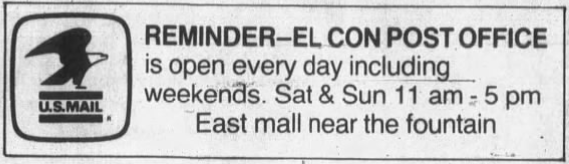
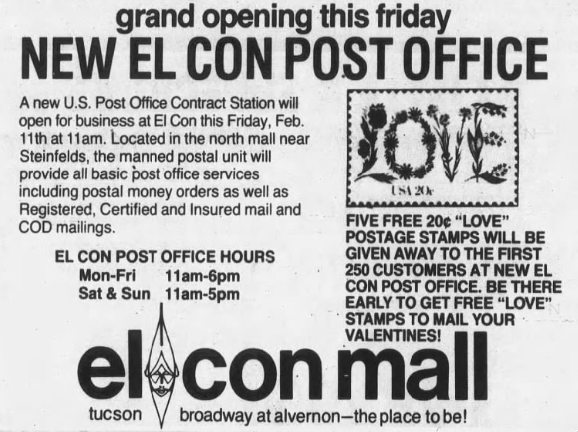
El Con Mall in Tucson, AZ, joined the growing ranks of US malls featuring a post office in 1983. The mall-based branch held its grand opening on February 11th. To celebrate the achievement, five 20¢ Love postage stamps were given to the first 250 customers—just in time to mail a card to their special Valentine. For many Tucsonans, the presence of a post office in the mall achieved two goals at once—It allowed them to shop and run errands in one convenient location. Some even used the El Con Post Office to save lives through contributions to a Chicago-based non-profit organization called Love Letters Inc.
The Machinery of Kindness
Linda Bremner started Love Letters Inc. in 1984, following the death of her son, Andy, from cancer. While Andy underwent treatment at a Chicago hospital, he grew accustomed to receiving cards and letters from friends and relatives. When Andy went home, the letters stopped. “Here was this poor child, dealing with all the frustration and pain of chemotherapy, looking up at me and saying, ‘Mom, did I get any mail today?’” Bremner revealed. “It just broke my heart.”2 Seeing an opportunity to help, Linda began mailing Andy letters addressed from his “secret pal.”
When Andy died in 1984, Linda channeled her grief into helping other kids with long-term illnesses. She wrote and mailed a 10-page newsletter packed with games, puzzles, jokes, and whimsical stories as a way to bring some much-needed light into the children’s lives. Bremner started with 20 kids. “Before I even got through the list, I got mail back from the kids telling me how much it meant to them that someone who didn’t have to care cared and had taken the time to brighten their day,”3 she said. By 1989, Bremner and her volunteers were sending their “love letters” to 500 children through their non-profit, Love Letters Inc.
As word of Bremner’s efforts spread, people around the country sent money and resources to help. In 1987, Bremner shared that postage costs averaged $300 a month. To help, syndicated columnist Judy Markey wrote an article raising awareness for Bremner’s selfless project. The response was overwhelming. Markey reveals that, before the column printed, “Linda had absolutely no idea how she and her daughter were going to eat or pay her bills and, more importantly, how in the world she was ever going to be able to continue sending ‘love letters’ to ‘her’ kids,” Markey explained. “And then you read the column. And now ‘Love Letters’ has $11,000 in the bank, $1,300 in stamps, and a Macintosh computer (donated by Apple) among its assets.”4
The letters and resources that poured in from every corner of the country allowed Love Letters Inc. to flourish. By 2003, the non-profit was sending more than 1,000 letters to children each week and over 63,000 pieces of mail each year. In addition to a core group of volunteers, Love Letters Inc. thrived thanks to donations from people everywhere. It also benefited from reliable resources, such as post offices in malls, which made it more convenient for people to send the needed supplies.
A Road We Must Travel
At some point, we’ve all found ourselves in situations where sending a letter or card is the only adequate way to express how much we care. People today speak derisively of physical mail, referring to it as snail mail. If technology is so great, why do people still send wedding invitations in the mail? Why do we send care packages to our kids in college? Why do we send cards to express our condolences to the family of someone who died?
I’ll tell you why: Because mailing letters and cards is the next best proxy for delivering the message in person. If you have a shred of doubt about how a simple letter in the mail can make a difference for someone, consider this anecdote Jody Temkin shared about Bremner and Love Letters Inc.:
Some children write back to Bremner, thanking her for the mailings and telling her about their lives. [One] child who had corresponded with Bremner for a long time wrote a note saying his doctor had told him he was dying. He wanted her to know she might not be hearing from him again, and that he had enjoyed Love Letters.5
Later, Temkin reveals that the boy did stop writing, and Bremner eventually found out he had died. When someone takes the time to write us a letter, it matters. The warmth and sentiment that a handwritten card or letter conveys is something technology can never duplicate.
Unfortunately, much of the infrastructure that made Bremner’s life-saving work possible is under threat. Few malls have post offices these days because people no longer spend time at the malls as they once did. As a result, one face of the architecture that made life easier for all of us has disappeared. This month, identify someone you haven’t talked to in a while. Write them a card or a letter, go to the post office, buy a stamp, and send it in the mail. Make it a monthly habit to send one parcel of mail through the post office. If we value the option to send letters and cards when necessary, we must act to support the physical infrastructure that makes this possible. If we don’t use the network, it will disappear—and when the pixels fail us (like with the sick parent), we’ll have no road left to travel.
Footnotes
1Brenner, K. (1991, July 29). Lents post office at mall is truly letter perfect. The Oregonian, p. 2.
2Temkin, J. (1988, August 14). Love letters brightens day for sick kids. Arizona Daily Star, p. 8.
3Hagin, D. (1989, July 9). A message of love for kids needing hope. Chicago Tribune, p. 1.
4Markey, J. (1987, September 13). Thanks to all of you for “Love letters” boost. The Daily Herald, p. 2.
5Temkin, J. (1988, August 14). Love letters brightens day for sick kids. Arizona Daily Star, p. 8.