Fuzzy Carpets and Gold Leaf: The Lost Art of the “Considered Detail”
They say you can tell a lot about a person by the shoes they wear. You can also tell a lot about a store by its flooring. Think about the last store you went to. What kind of flooring did it have? Likely a slab of industrial polished concrete, vinyl planks mimicking hardwood, or a monolithic grid of modular carpet tiles. These flooring choices read like blueprints of the questions that keep a store owner up at night: What can sustain heavy traffic? How easy is it to clean? How can I avoid a slip-and-fall lawsuit? Stores that implement these flooring styles are not trying to impress you; they are doing what they can to minimize maintenance, lower their costs, and keep their customers safe. In other words, the store is looking after its bottom line. The store gets profits and peace of mind, while the customer gets a generic atmosphere indistinguishable from nearly every other store in town.
The Tennis Ball Carpet
The other day, I went to CVS to pick up a prescription. Beneath my feet was a sea of charcoal modular carpet tiles. Due to high traffic, many had a fuzzy texture, like the felt of a worn-out tennis ball. These tiles were chosen for their durability and stain-concealing properties, but they made the store feel cheap—like a polyester suit from the 1970s. The message this flooring conveys to customers is, “You’re only here for five minutes, so we’re not putting a penny more into these floors than we have to.
The 16-Page Standard
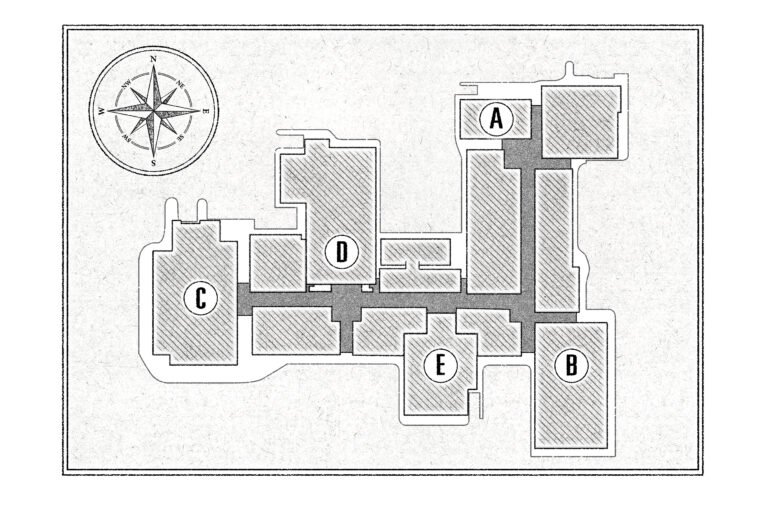
Now, let me introduce you to a store that took the opposite approach: Levy’s department store. Levy’s was the first store to open at El Con Mall in Tucson, an institution that quickly gained a reputation for putting the customer first. Levy’s outgrew its first store (“A”, map below) at the mall in less than a decade. In 1969, they moved into a new building (“C” map below) on the west wing of the mall that was four times the size of the original.
One of the clearest signs that Levy’s was no ordinary store comes from the Tucson Citizen newspaper. The day before the store’s grand opening, the newspaper featured an entire section with articles offering a behind the scenes look at the store. The Levy’s Section, 16 pages in all, includes a look at what’s new, a history of Levy’s, featured departments, and articles spotlighting the artists and designers who gave the store its signature look. When have you heard of a newspaper devoting 16 pages to cover a store opening? This never happens. A store opening in 2026 might get an Instagram post, if anything.
Artistry and Estate Sales
This newspaper section alone tells you that Levy’s was no ordinary store. Most stores don’t hire muralists to create decorative panels on the walls, as Levy’s did with John and Marion “Tish” Ayres Albright. These talented artists spent several months consulting with the store’s interior designer, T. Richard Dolan, to develop a plan. A month and a half before the grand opening, they flew to Tucson after completing a project for the New York Stock Exchange. They worked for two weeks on the Levys’ murals. As reported in the Citizen, “A specialty of the Albrights are gold leaf roses, full blooms such as are found in the women’s dress salon, and around the center core shops on the main floor—hosiery, handbags, jewelry.”1
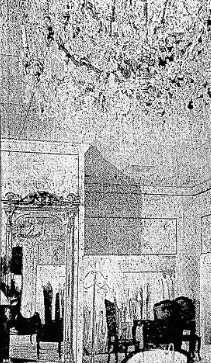
In another article, we learn of Levy’s impressive collection of display antiques. “What makes the new Levy’s store different from many other large department stores around the country?” asks the Citizen. “One reason: the many antiques and home furnishings used as display fixtures … or ‘just there’ for beauty’s sake alone.”2 Levy’s spent thousands on antiques, many sourced locally from the Antique Furniture Gallery on Broadway. Perhaps the most eye-catching of them all was a crystal chandelier purchased at an estate sale in New York from a home slated for demolition. It served as the focal point for the high-fashion salon in the women’s department. The article ends with this apt assessment: “All together, 21 pieces … carefully blended with Drexel and Heritage cabinets, tables, sofas and chairs … adding a unique warmth to the standard fixtures and display cases.”3
After the Lights Went Out
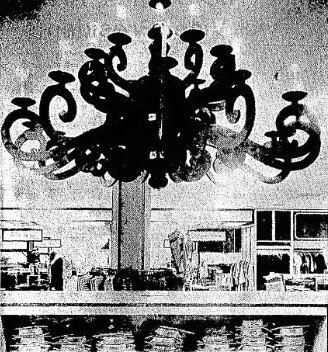
It’s the little flourishes like these that turn a store from a place to shop to an experience. I particularly enjoyed reading about the Men’s Department at Levy’s. “The atmosphere is masculine … deep wood tones contrast with rust-orange, beige and browns,” the Citizen reveals. “Some areas are carpeted, others utilize teakwood parquet.”4 A huge iron chandelier served as the focal point of the department, hanging above racks of sport shirts. “An especially attractive area within the men’s department is the new gift area. Model ships, unusual games, bar accessories are available in a variety of price ranges.”5 By the time I was old enough to buy my own suits, the iron chandeliers and teak floors were but a memory. Looking at these archives, it’s hard not to feel like I showed up to the party after the lights were turned off.
The Six-Year Clock
There are so many more interesting details of the store to discuss; far more than I can cover in this post. One article in particular, regarding the store’s parquet teakwood floors, demands mention. Most Levy’s shoppers would never suspect the fascinating history of the teakwood flooring they walked on while shopping. The material used to produce Levy’s parquet flooring came from old-growth teak trees, 60 to 160 years old, in the forests of Thailand.
After girdling, these trees were cut down, dragged by elephants through the forest, and floated downriver to a sawmill. The logs were then inspected, auctioned, and transported to a kiln plant in Bangkok, where they were slowly dried and used to manufacture plank flooring. Six years after the trees were cut down, they arrived in the United States as parquet tiles.
The Signal of Value
Think back to those fuzzy carpet tiles. I’m not suggesting that CVS stores should have parquet teakwood flooring. That would be overkill. What I’m calling attention to is how far expectations have slipped over the years. In the past, even pharmacies had ceramic black and white tiles. There was a standard of seriousness that most stores held themselves to, and it showed in the corners they refused to cut. That’s no longer the case. Most stores are in a race to the bottom, eschewing quality for the cheapest option. We’ve become accustomed to this because so many stores do it. We expect the bare minimum, the stripped down, the generic. We no longer walk into a store expecting an experience.
The lesson of Levy’s is that we, as a culture, lose something essential when stores prioritize profits over people. Levy’s owners required the same durability from their floors as today’s CVS stores, but they invested in some of the best hardwood flooring available to ensure their customers would feel seen. Much has changed since the 1960s, and given our awareness of environmental sustainability, I would no longer support the use of teakwood floors in department stores. Still, we can do better. We should demand more of our stores. Bring back some of the pride that companies took in providing a good experience for their customers. Pay attention to the “considered details” the next time you enter a store. That polished concrete isn’t just a floor—it’s a signal of how much the company actually values you.
Footnotes
1Wall panels decorated by young pair. (1969b, September 15). Tucson Citizen, p. 10.
2Antiques not for sale. (1969a). Tucson Citizen, p. 9.
3Ibid.
4Men’s clothing displayed well. (1969c). Tucson Citizen, p. 12.
5Ibid.