One of the benefits of living in Tucson, Arizona, is having clear blue skies. It’s one of the main reasons that Tucson is a hotbed for astronomy. It wasn’t until I moved away to attend a midwestern college that I appreciated how lucky I was to live in a place where the sun and sky were visible most days, unobscured by clouds. This atmospheric feature is a characteristic of life in the Sonoran Desert: A biome known for its high atmospheric stability, the measure of an atmosphere’s resistance to vertical air motion. Tucson’s high atmospheric stability creates the perfect conditions for cloudless, deep blue skies for most of the year.
The Great Tucson Fog of 1970
Though one of two rainy seasons of the year, Tucson winters are generally a time for clear skies as well. That was not the case in December 1970, however. That year, a thick fog covered the city from December 28 to 30. On the morning of December 29, the rare weather condition wreaked havoc at Tucson International Airport, causing it to close for thirty minutes and forcing an inbound plane to circle for an hour until visibility improved. The Tucson Citizen newspaper captured the novel weather conditions with this poem:
Later that evening (December 29), the Citizen followed this clever rhyme with a photo of the mountain ranges surrounding the city, wreathed in fog. The caption read,
Not The Clear Day When You Can See Forever: The fog crept in on little wildcat feet in the mountains surrounding Tucson yesterday and again this morning. The sprawling metropolis of Tucson was completely hidden by this fog cover which reaches for many miles from the 6,000-foot level of Windy Point Vista, on the Mt. Lemmon road, to ‘A’ Mountain.2
The evening fog enveloped Randolph Park and the nearby El Con Mall, located on the other side of Broadway Boulevard. Montgomery Ward, the southernmost store location at the mall, looked directly out onto Randolph Park. Imagine looking out the store entrance and seeing the El Con parking and the park beyond it blanketed in a thick white fog. It must have been surreal. Little did those Tucson shoppers know that thirty-two years earlier, the very company (Montgomery Ward) whose store they were standing in had birthed a legend out of a similar fog.
From the Old Pueblo to the Windy City
Due to their rarity, the December fog days of 1970 became legendary in Tucson. Similarly, thirty-two years earlier, a foggy day in Chicago became the inspiration for another widely recognized legend—the story of Rudolph the Red-Nosed Reindeer. In January 1939, the inventor of Rudolph, Robert L. May, faced a bleak situation. May’s wife, Evelyn, was battling cancer, and the medical expenses were piling up. May worked as a catalog copywriter for the Montgomery Ward department store in Chicago. It paid the bills, but prevented May from pursuing his lifelong dream of authoring the next great American novel. Here, in his own words, is a description of May’s sullen outlook in January 1939:
An icy January blast tore at my coat as I hurried on my way to work. I noticed that the Christmas street decorations had been taken down, and in a way, I was relieved. My wife was suffering from a long illness, and I didn’t feel very festive.
I was glad to get inside the foyer of the Montgomery Ward building. In the elevator, I leaned back and listened to the younger men eagerly discussing their work.
‘And how are you starting the new year?’ I glumly asked myself. Here I was, heavily in debt at age 35, still grinding out catalog copy. Instead of writing the great American novel as I’d hoped, I was describing men’s white t-shirts.3
A Flash of Inspiration
Later that morning, May was summoned to his boss’s office. Each year, Montgomery Ward, a mail-order business headquartered in Chicago, outsourced the production of its Christmas promotional giveaway. In 1939, however, the company decided it was time for a change. “Bob,” said May’s boss. “I’ve got an idea. For years, our stores have been buying those little Christmas giveaway coloring books from local peddlers. I think we can save a lot of money if we create one ourselves. Could you come up with a better booklet we could use?”4 May was directed to create a story with an animal as the main character, like Ferdinand the Bull, a popular children’s book published in 1936. May accepted the challenge and began working on the story.
That night, May worked out the basic story elements. Since it took place on Christmas and was May’s daughter Barbara’s favorite animal at the zoo, May made the main character a reindeer. May was bullied as a child and identified with underdogs, so the reindeer became an Ugly-Duckling-type character. But how to make the reindeer special? As May mulled the possibilities, the weather outside enabled a flash of inspiration. “Outside, the fog swirled in from Lake Michigan, dimming the street light,” May observed. “Light. Something to help Santa find his way on a night like this.” May knew he was onto something. “Speed and strength hardly seemed qualities which made for an underdog, but flying in all sorts of weather seemed to have possibilities.”5
Initially, May considered giving the reindeer glowing eyes. “I first thought of some kind of light coming from the reindeer’s eyes, like the reflective light from a cat’s eyes,”6 said May. Then he got the idea to give the reindeer a glowing nose, given people’s tendency to laugh at unusual noses. “Suddenly, I had it!” said May. “A nose! A bright red nose that would shine through fog like a flood light.”7 The following morning, May eagerly presented the idea to his boss, who rejected it. Undeterred, May enlisted his friend in the company’s art department, Denver Gillen, to meet him at the Lincoln Park Zoo’s deer corral that weekend to sketch a red-nosed reindeer. May submitted the sketches to his boss the following Monday, and this time the story was approved.
The Legacy of the Red-Nosed Reindeer
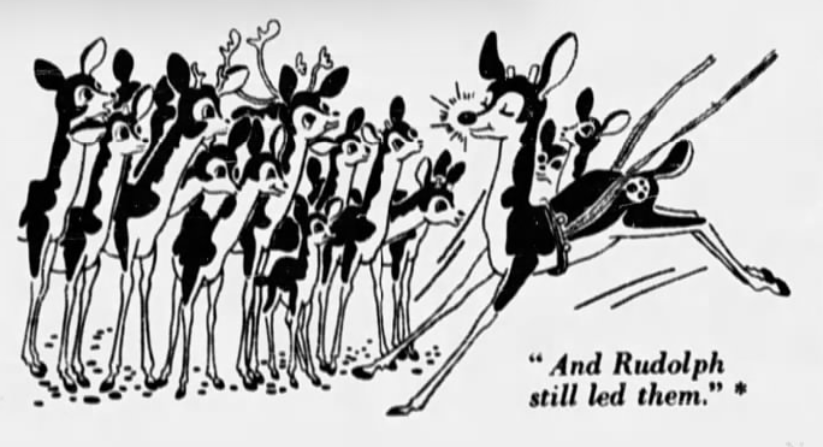
In 1939, Montgomery Ward gave away 2,365,016 copies of Rudolph the Red-Nosed Reindeer. Due to World War II paper shortages, the story was shelved for the next seven years. After the war, Montgomery Ward brought back the popular storybook for the Christmas 1946 season. That year, the store gave away 3,476,000 copies of the book. Since then, Rudolph the Red-Nosed Reindeer has taken his place alongside Santa Claus as one of the iconic Christmas legends.
In my adult years, the fog has emerged as my favorite element of the story. Were it not for the fog in Chicago that day, May might never have invented the reindeer with a glowing nose. The fog also creates the conditions that bring out the best in Rudolph. It’s a metaphor for the difficult moments in life that force us to rise to the challenge. May faced such a moment later that year when his wife passed away on July 28, 1939. May’s boss offered to help. “Bob, I can understand your not wanting to go on with the kids book,” he said. “Give me what you’ve got and I’ll let someone else finish it.”8
May refused: “I needed Rudolph now more than ever,” May said. “Gratefully, I buried myself in the writing.”9 May finished the book a month later, and, like Rudolph, it went down in history. In 1975, May described the significance of his achievement this way:
Today, children all over the world read and hear about the little deer who started out in life as a loser, just as I did. But they learn that when he gave himself for others, his handicap became the very means through which he achieved happiness.
My reward is knowing that every year, when Christmas rolls around, Rudolph still brings that message to millions, both young and old.10
And here’s one more message: Blue skies and sunny days are wonderful, but fog days force us to dig deep and find the light.
FOOTNOTES
1Airport socked with fog. (1970, December 29). Tucson Citizen, p. 1.
2White, L. (1970). Not the clear day when you can see forever. Tucson Citizen (p. 1). photograph, Tucson, AZ.
3May, R. L. (1975, December 22). Robert may tells how rudolph, the red-nosed reindeer, came into being. The Gettysburg Times, p. 16.
4May, R. L. (1975, December 22). Robert may tells how rudolph, the red-nosed reindeer, came into being. The Gettysburg Times, p. 16.
5May, R. L. (1975, December 22). Robert may tells how rudolph, the red-nosed reindeer, came into being. The Gettysburg Times, p. 16.
6Red-nosed Rudolph wins a spot beside virginia in heart of santa. (1964, December 8). Tucson Citizen, p. 14.
7May, R. L. (1975, December 22). Robert may tells how rudolph, the red-nosed reindeer, came into being. The Gettysburg Times, p. 16.
8Red-nosed rudolph wins a spot beside virginia in heart of santa. (1964, December 8). Tucson Citizen, p. 14.
9Red-nosed rudolph wins a spot beside virginia in heart of santa. (1964, December 8). Tucson Citizen, p. 14.
10Red-nosed rudolph wins a spot beside virginia in heart of santa. (1964, December 8). Tucson Citizen, p. 14.