The Killer in the Ring
You’d think the scariest thing a matador faces in the bullring is the bull, right? Who wouldn’t be terrified of a charging 1200 lb. beast with horns capable of disemboweling you with a single errant hook? Every time a matador steps into the bullring, he knows the day may end with his bloody corpse lying in a morgue. Still, the bull isn’t his greatest fear. Can you guess what is?
It’s the wind.
It isn’t the color of the cape that triggers the charge; bulls are colorblind. It’s the movement. A matador uses the movement of his cape—the capa de brega—to entice the brute while keeping his own body out of reach. This is why he fears the wind. A sudden gust is a wildcard that could turn a precision pass into a fatal impalement.
The Cuadrilla and the Matador
I’m Irish by name, but I was raised in the cuadrilla of my mom’s Hispanic family. Growing up, the hub of all our family activity was my Nana’s house. It’s where my family and all our relatives met for dinners, birthdays, and holiday celebrations. Nana had a framed picture of a Spanish bullfighter that hung in her living room. The name of the painting is The Matador, by Rico Tomaso.
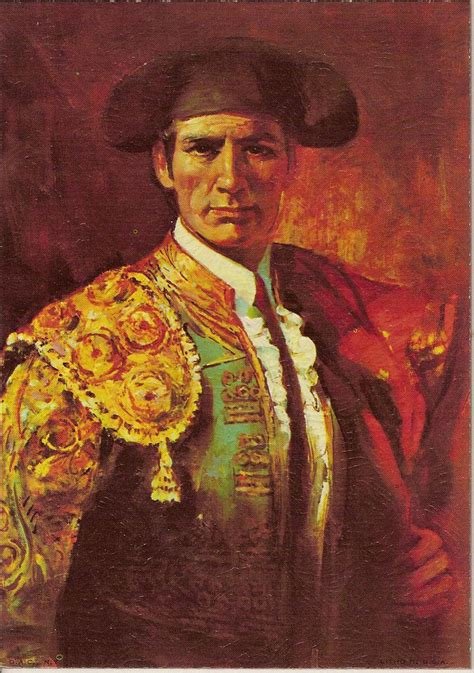
This image of a strong, supremely confident bullfighter posing in his traje de luces embodies the traditional Spanish filter overlaying all my childhood memories at Nana’s house: The concrete garden statue of a donkey with flower baskets that Nana used to hold the front door open, the black porcelain bull statue in her living room, the smell of freshly-made tortillas wafting from her kitchen, Vicente Fernandez records playing on the stereo, and the sound of Mom and Nana conversing in Spanish when they didn’t want us kids to know what they were talking about. Every time I see the Matador picture, it conjures these memories.
The Shifting Winds of Validation
In the Digital Era, the way we relate to images has changed significantly. I experienced life before the Internet, when people didn’t take pictures of themselves all the time. Picture taking was reserved for class pictures, birthdays, vacations, weddings, and holidays. We weren’t inundated with images, so the ones we encountered regularly, like Nana’s Matador painting, stood out. Today, the painting wouldn’t stand a chance amid the bull rush of images that trample our attention every day.
Unfortunately, for many people today, the motivation for engaging with images is often self-centered. As the matador uses his capa de brega to coax the bull to charge, people use pictures to get attention. We put on a performance, broadcasting curated versions of ourselves to the world, but the bull never tires. Validation is always contingent on the next successful pass, and the shifting winds ensure this is never a guarantee. When a matador is in the bullring, 100% of his attention is focused on the bull. He doesn’t have time to think about who he is.
Why not leave the bullring? Stop pursuing trophies of ears and tails and go on a pilgrimage for an anchor instead.
The Traveling Chapel
One established tradition among matadors is the travelling chapel, or capilla portátil. This is a portable religious sanctuary, small enough to fit in a suitcase, that they take with them everywhere they go. When the matador arrives at his hotel room, one of the first things his assistant, or Mozo de Espadas, does is set up the travelling chapel on a desk or table. This mini sanctuary contains a linen cloth, religious iconography, candles, photographs, and flowers. Some may find this quaint, but if a job required putting your life on the line every time you clocked in, seeking divine protection would be a priority for you, too. Despite the changing variables that come with life on the road, the capilla portátil is a constant. This familiar sight is an anchor that the matador can always turn to for reassurance.
Images can do the same for us. With all the distractions modern technology introduced into our lives, it’s tough to know who the real person is underneath the carefully crafted volumes of filtered photos we post for others. One way to begin figuring it out is by identifying an image that captures a bedrock truth of your soul. Search for an image that speaks to you. When you find it, listen. It reveals something about who you are. This is part of your capilla portátil (travelling chapel).
Sanctuary at El Con Mall
The Poster Warehouse at El Con Mall in Tucson was where I found the first element of my travelling chapel. This warehouse-sized store had framed paintings on every wall and an interior floor space riddled with poster flip racks. I wandered into the store one day in 1995, drifting through a leave of absence from college and feeling entirely lost. My life was an abandoned arena; not a soul was in sight, and the glory of all my previous victories gone with the wind.
I browsed through the poster racks, which made a distinct clacking sound as the metal frames collided with every flip. I found a print by artist Schim Schimmel, featuring a black panther prowling Earth’s surface. With head lowered and eyes locked on something in the distance, the panther strides confidently from a cloud of fog. The caption read, “In Search of His Future.”
I bought the poster that day, had it framed, and hung it in my bedroom. This was the first serious piece of art I ever bought for myself, and it meant a great deal to me because it required an act of choice—I had to pull it from the rack, pay for it, and give it physical space on my wall. This picture became the first element of my travelling chapel, an anchor in my early adult life.
From Novillero to Matador
Don’t be a victim of the changing winds. Find the courage to leave the bullring. You don’t need the applause of adoring crowds to be happy. Instead, invent your own Camino de Santiago. Go on a pilgrimage to find the elements of your capilla portátil. Images can help with this. One element of my nana’s travelling chapel was the Matador painting by Rico Tomaso. For me, it was Shimmel’s panther. What elements make up your travelling chapel? If you don’t have any, start looking. Modern life is a brutal bullfight, and everyone needs familiar anchors to progress from a novillero to matador de toros.