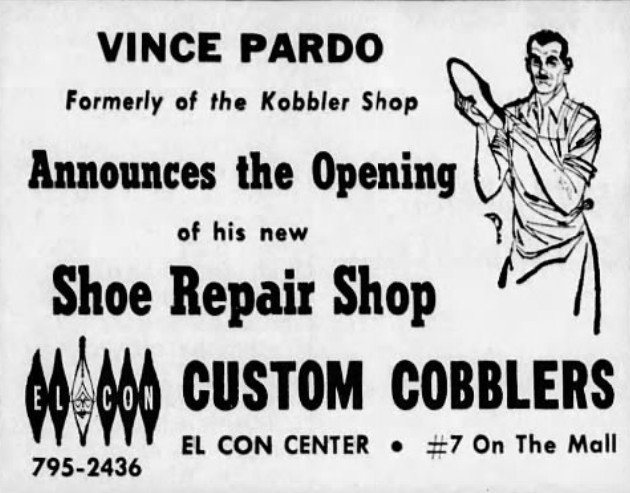
The grand opening of El Con Custom Cobblers occurred on November 22, 1963, the day of President Kennedy’s assassination. Pardo maintained a presence in El Con for the next 48 years, making El Con Custom Cobbler the longest-running tenant in the mall’s history. Pardo, a Detroit native, was introduced to the trade at fourteen, after peeking inside a store to watch a shoerepairman work. The Italian craftsman put Pardo to work, and he never looked back. “When I started to learn how to repair shoes, I figured that’s what I was going to do,”4 said Pardo.
And repair shoes he did. Pardo refined his craft over the years, learning new skills from others whom Pardo called “masters of the field.” Over time, Pardo established himself as one of the best cobblers in Tucson. “The quality is impeccable, and the service is the best,”5 said Jim Livengood, former University of Arizona Athletic Director. El Con Custom Cobbler was among the handful of stores still in business in 2011 when the mall was torn down. Trendy, modern stores are staples in shopping malls, but when things got tough, these stores disappeared from El Con Mall. They couldn’t adapt to the changing retail trends, but El Con Custom Cobblers, relying on an age-old craft, continued chugging along year after year.
Skill Acquisition vs. AI Shortcuts
The level of skill required for both Jim McFarland and Vince Pardo to create and sustain their successful shoe repair businesses takes years to learn. In the video, McFarland reveals that he is a fourth-generation cobbler. The family business began in 1900 with McFarland’s great-uncle, who passed it on to his grandfather, who passed it on to his father, and ultimately to him. McFarland has also taken steps to ensure the family legacy continues by teaching the trade to his nephew, Kyle.
The protracted learning curve is a big reason why the cobbler trade is a dying art. Pardo acknowledged as much in a newspaper interview, citing the difficulty in attracting younger people as the industry’s biggest threat. “I’m too old to train someone to take over for me,” said Pardo in 2009, 46 years after opening El Con Custom Cobbler. “It takes a lot of patience to train someone.”6
When you realize how much skill and training are required of cobblers, it’s not difficult to understand why McFarland’s videos are so popular on TikTok. The skill required to transform a dilapidated, worn-out shoe or boot into something that looks new again requires a level of training that few possess. It’s not something you can fake, a perfect counterpoint to the new breed of automated content creators who rely exclusively on AI to produce their work.
For example, a growing number of content creators are using AI to produce material at rates that few, if any, non-AI-assisted creators can match.
Whether writing blog posts or producing YouTube videos, with a few simple prompts, these automated content creators get AI to do all the work for them. No need to be subject matter experts or spend years honing their craft. Automated content creators simply direct AI to write a blog article on any given topic, and seconds later, they have the makings of a post ready for upload. It’s perfectly legal, but is it the right thing to do? And is the work produced truly valuable, or does it simply add to the sea of algorithmically generated, disposable content cluttering the digital landscape? These are questions every content creator must answer for themself. To help illustrate the difference in value, I offer a metaphor from the world of shoe repair.
ALGORITHM Constructed CONTENT: A SHOE WITh GLUED SOLES
One of the hallmarks of a quality shoe is stitched leather sole construction. Leather shoes featuring soles with either a Blake stitch or Goodyear welt can be resoled many times by a cobbler, extending their life and, thus, increasing the shoe’s value. Unfortunately, most shoes today are made with cemented construction, meaning the soles are glued. These shoes are often of inferior quality, so when the sole wears out, it’s more cost-effective to discard them and buy a new pair.
In 2009, Vince Pardo revealed that the biggest change he observed in 63 years working as a cobbler was in the quality of shoes produced. “There are too many junk shoes out there that are not worth fixing,” Pardo complained. “I don’t think shoes can get any worse than they are now when soles are being made of pressed paper and cardboard.”7
AI is a wonderful tool, and when leveraged correctly, it can accomplish great things. In my opinion, however, Faceless YouTube Channels and blogs featuring content fully generated by AI are the equivalent of glue-cemented soles in the shoe world: They get the job done, but they will never be more than a temporary means to an end. And they will never provide lasting value.
YouTube is filled with how-to videos from content creators promoting the leveraging of AI to create faceless video channels. In most cases, every aspect of video production—content creation, voiceover, background imagery, music, and editing—is achieved using AI. Faceless videos get monetized, earning money for the individuals or groups that “created” them, when in reality an algorithm did all the work. Is that fair? Does it provide true value? While profitable, I believe these methods fundamentally fail to meet the standard of lasting value set by true craftsmanship.
Reaching the Soul Level
In contrast to automated content creators are true craftsmen like Jim McFarland and Vince Pardo. After playing snippets from several of Tori McFarland’s videos, the NBC News segment shows a sampling of comments from TikTok users posting their reactions to seeing Jim McFarland at work:
- A true master at his craft
- You’re an artist my guy
- Truly an art
While faceless YouTube channels and AI-generated blogs may make the individuals who launch them rich, they will never garner the kind of admiration that true craftsmen like McFarland and Pardo elicited over the years from their customers. AI can do many things, but it can’t replicate the earned value that makes a product transformative. You may get rich taking shortcuts, but you will never reach people at the soul level through your work. While automated content creators pursue shortcuts to wealth, true craftsmen like McFarland and Pardo remind us that only by honing our skills and talents over the years can we produce something worthy of respect and admiration.
Choosing Craftsmanship Over the Quick Buck
The NBC Nightly News segment ends with this observation by Sam Brock: “He’s [McFarland] touching souls for sure. The ones on our feet and those in our hearts.”8 If making a difference in other people’s lives is important to you, spend time developing a skill you can use for good in the world instead of leveraging technology to do the work for you to make a quick buck. On the path to creating something of true value, there are no shortcuts.