Bringing the Outdoors In
For much of my career, I have been a teacher; however, nature and the environment have always been a passion of mine. After college, I always thought I’d end up working for either an environmental organization or somewhere that allowed me to work outdoors. I love being in nature, so my current job as a P.E. teacher suits me fine. I get to be outside every day, feeling the sun on my skin, and that calm afternoon breeze that comes every day around 2 P.M. in Tucson. Though I no longer teach indoors, when I did, I made it a point to bring a little of the outdoors into my classroom every day. My former students could attest to this. Here’s how I did it.
Technology and Nature-Deficit Disorder
Our modern overemphasis on technology has certainly impacted the number of hours kids spend outside, and not in a good way. Technology contributes to nature-deficit disorder, a concept introduced in Richard Louv’s book Last Child in the Woods. The term describes the negative health impacts on children who don’t spend enough time outdoors. Spending too much time on phones, computers, and gaming devices, three of the primary technological time-thieves, contributes to this. But, I figured out a way to leverage technology to combat nature-deficit disorder in my classroom: I used an overhead projector to project ambient videos featuring scenes of and sounds of nature. Every time a new class entered my room, they saw a window to the natural world projected on the classroom wall. One day, it might be a gentle forest stream, and another day it might be a grass-covered slope in the Swiss Alps. Every one of my classes began this way, and I found it calmed down the kids as a bonus.
A Wilderness of Sweets
Some of my personal favorite videos featured bird sounds. I recall one in particular of a prairie scene with swaying tall grass and wildflowers. This video was one of my go-tos. Not only did it make me feel like I was outside, but it filled me with nostalgia for my childhood days. I never knew why, until now. I’ll tell you why in a moment, but first, a bit about the notion of variety.
Mother Nature is the world’s best teacher. One of the reasons nature is so effective is the sheer variety of experiences it provides. In Last Child in the Woods, Louv alludes to this variety while attempting to define what nature is. Louv references the nature poet, Gary Snyder, who was drawn to a phrase from John Milton’s poem, Paradise Lost. While describing the Garden of Eden, Milton uses the phrase “a wilderness of sweets.” After noting the phrase, Louv references a quote from Gary Snyder, who, in his book The Practice of the Wild, says this:
Milton’s usage of wilderness catches the very real condition of energy and richness that is so often found in wild systems. A ‘wilderness of sweets’ is like the billions of herring or nackerel babies in the ocean, the cubic miles of krill, wild prairie grass seed … all the incredible fecundity of small animals and plants, feeding the web.1
Man-Made Environments vs. Nature’s Bounty
The reason modern technology is such a harmful contributor to nature-deficit disorder is that it keeps people indoors rather than out. Louv alludes to this problem while quoting a fourth-grade student in San Diego named Paul, who said, “I like to play indoors better, ‘cause that’s where all the electrical outlets are.”2 When people consistently confine themselves to man-made environments for extended periods to use electronics, they gradually cut themselves off from the cornucopia of sensory delights and wonder that nature offers. Instead, they are fed an artificial reality by algorithms that limit what they see more and more with every profile-defining mouse click.
Paul’s world is defined by what he can take in through his eyes and ears via an electronic device. But before our horizons shrank to the confines of a digital screen, we had the mall—a place that, for all its artificiality, still demanded we move, breathe, and navigate a landscape that mimicked the outside world. Malls have taken a lot of flak over the years (i.e., temples of consumerism, shrines to materialism), but even they offered better access to nature than today’s sit-and-scroll-on-the-couch culture. Remember the planters scattered throughout your mall, overflowing with Peace Lilies, Pothos, and Areca Palms? Or the glass-covered atrium with tall Indian Laurel trees? Or the lighted fountain with its cascading jets of splashing water? Though these are only approximations of Nature’s bounty, they do a much better job of putting us in touch with the natural world than anything that requires a glass screen can offer. And it didn’t end there. One of the best places to experience nature’s variety in the mall was in a variety store. I’ll explain.
The Panoply of the Five-and-Dime
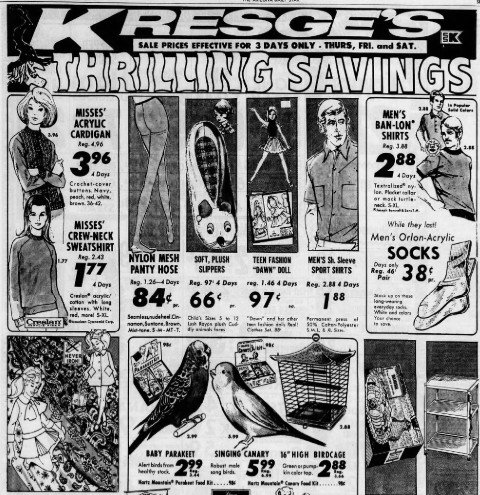
First, a variety store is another term for a five-and-dime store, so-called because everything for sale in the store, at least in the early days, cost a nickel or a dime. Some of the most successful variety store chains of the 20th Century include Woolworth’s, S.S. Kresge, W.T. Grant Co., J.J. Newberry’s, and McRory’s. El Con Mall in Tucson, Arizona, had two variety stores: Woolworth’s and S.S. Kresge. Like nature, a panoply of sensory experiences lay in wait for customers who entered these stores. They carried every gadget you could think of, from thimbles to balsa wood model airplanes. Need a new pair of slippers? Aisle three. Sprinkler head for your hose? Horticulture Department. While you’re at it, there’s a lamp for your living room. And before you leave, be sure to stop by the diner for some Southern Fried Chicken or perhaps a triple scoop of ice cream.
The Bird Wall and Nana’s House
Perhaps the wildest thing about variety stores, pun intended, was that they contained a Pet Department. Entering this section of the store, you were greeted by a cacophony of chirps and tweets from rows of stacked cages known as the “bird wall.” Here, the store sold parakeets, canaries, and other birds, as well as fish, turtles, and hamsters. Parakeets were popular pets in the 1970s and 1980s, particularly the Budgerigar variety, commonly known as Budgies. My nana had a pair of Budgies, one green and yellow, the other light blue and white. She kept them in a cage in her dining room. One reason I loved going to her house was to see the parakeets; I distinctly remember coloring in Nana’s living room and hearing the Budgies chirping at random intervals while Mom and Nana talked at the dining room table. You could also hear the flit of their wings beating and their feathered bodies crashing against the thin wire mesh of the cage walls. The presence of these birds in Nana’s house gave it a special kind of energy.
The Legend of Karp
In addition to infusing a space with vitality, parakeets make great pets. In discount stores like Woolworth’s and Kresges, you could buy a parakeet for under $5, and pick up a cage, starter kit, and feed for minimal expense, too. Their affordability is part of what made parakeets so popular. In no time flat, the parakeet became a beloved member of the family. Just ask Mr. and Mrs. John Vick, who lived on Alamo Ave near St. Joseph’s Hospital in Tucson, Arizona. In 1978, the Vicks lost their parakeet, Karp, when Mr. Vick absentmindedly walked out of the house with the bird on his shoulder. The Vicks taught the bird to say over 100 words and sounds, including barking like a dog and the phrase “dirty birds need love, too.” Mrs. Vick told Tucson Citizen writer Dan Huff that losing Karp was like losing a family member. The Vicks offered a $25 reward for finding the bird and continued their neighborhood search. It’s unclear if they ever found Karp, but evidence suggests the bird was alive days after it escaped. Apparently, a woman in the neighborhood reported that she was washing dishes when a bird alighted on her windowsill, began barking, then flew away.3
An Analog Experience of Nature
Thanks to the parakeet craze of the 1970s and 1980s, I experienced the unique energy that comes with having these birds in your home. I learned to associate the chirping and tweeting of these birds with feelings of comfort, because they were a standard feature of Nana’s house. Years later, as a teacher, I suppose the reason I gravitated to ambient videos featuring birdsong was that I associated the sound with Nana’s parakeets. These days, many frown on the practice of keeping parakeets as pets because they’re forced to live in cages. I’m not here to say whether it is good or bad. I think as long as you provide them with the companionship of other parakeets and have a designated room or, better yet, aviary, where they can fly unrestricted, it can be a good thing.
One thing I can say for certain, however, is that these birds provided an analog experience of nature that is sorely lacking in the world today. Sure, anyone can get a dog or a cat today, and they’re phenomenal pets, too. Still, having a bird as a pet is totally different. Perhaps it’s because birds can never be fully domesticated, and they never lose the quality of wildness that we associate with nature. Whatever the reason, parakeets are fascinating creatures. While many today may look down on keeping them as pets, they afforded me an experience of nature you can’t replicate through a digital image on a screen.