The Modern Customer Service Nightmare
You’ve been avoiding it all week, but that contested bill for a service that should have been covered is now a looming shadow. You see it lying there on the TV stand, and the knot in your stomach tightens as you realize that today is the day you must confront the gathering storm. Determined to face your fear, you sit down, take a deep breath, and call the customer service line—bracing for the gauntlet of frustration that’s sure to follow.
The assault on your patience begins immediately with a useless 2-minute diatribe, filled with inane corporate babble designed to slow you down: “Thank you for calling XYZ. We value your time and business. Did you know you can skip the wait and manage your account faster online?” Thanks, Captain Obvious. Next comes the phone tree labyrinth, where you punch button after button on your phone, hoping that one leads to an actual person. It’s a digital maze of menus and submenus. You’re never quite sure where it is leading and often end up right back where you started.
Following several failed attempts, you eventually escape the virtual rabbit hole and gain access to the service area you’re seeking. After entering your account number, date of birth, and blood type, you linger in hold purgatory for 47 minutes, where you are forced to listen to the same annoying song on an endless loop:
“Da-da-ta-tat, ta-tat, ta-tat-taaah (Pause for a robotic voice: “Your call is important to us…”) Da-da-ta-tat, ta-tat, ta-tat-taaah, (Pause: “Did you know you can visit us online?”)
Finally, after enduring the company’s 111th apology for the long wait, someone answers. You state your name, and the representative asks you to verify your account number, date of birth, and blood type all over again. Remind me, why was I required to enter this information before if I have to repeat it the moment someone answers the phone? Then comes the game of Pass the Potato. The representative explains they don’t have the authority to fix this problem and, before you can say another word, transfers you to another department. One of two things happens next: You are banished to voicemail island, or you hear a click. The call was dropped, and it’s back to the start of call center hell you go.
The Levy’s Legacy: A Culture of Decency
We’ve all experienced this nightmare before, but customer service wasn’t always this way. To see a healthy contrast to our modern madness, look no further than Levy’s Department Store in Tucson, Arizona. In a previous post, I discussed the grand opening of Levy’s at El Con Mall (read about the exciting days in the year-long lead-up to the store’s opening HERE). In this post, you’ll learn about Levy’s founders, who prioritized decency, providing value, and good customer service. All three qualities were evident in Edward Fillmer, a man who occupied three roles at the new El Con store location: Credit Manager, Personnel Manager, and Store Superintendent. As you’ll see later, Fillmer was a man who refused to let someone leave the store disappointed. But first, a bit about Levy’s origins.
Though many Levy family members contributed to the store’s legacy, Jacob Levy, the founder, infused the store with his heart and soul. Jacob Levy was the son of immigrants, born on October 8, 1877. Jacob’s father died when he was seven years old, and by age nine, he assumed responsibility for the family with his mother. Jacob’s mother was described as “A strong woman, who had a good head for business and a firm conviction about honesty and decency.”1 Those character traits rubbed off on Jacob, for as the Tucson Citizen newspaper noted in 1969, “Honesty and decency became the creed of Jacob’s life, personally and in business.”2
From a Texas General Store to Tucson’s Retail Landmark
Jacob Levy was operating a store in Floresville, Texas, when his brother, Ben, who worked for the railroad in Bisbee, Arizona, wrote a letter to Jacob about a smelter being built in the nearby city of Douglas, and the large community springing up around it. “They sure could use a store there,”3 Ben wrote. So Jacob and his wife, Mamie, moved to Douglas in 1903 and opened the Red Star General Store. They sold high-demand items to the booming community, like pots, pans, socks, ties, dishes, carpets, and washboards. It was a modest store, but Jacob did what was necessary to get it off the ground—including sleeping in the back of the building at night and taking turns covering the counter with his wife.4
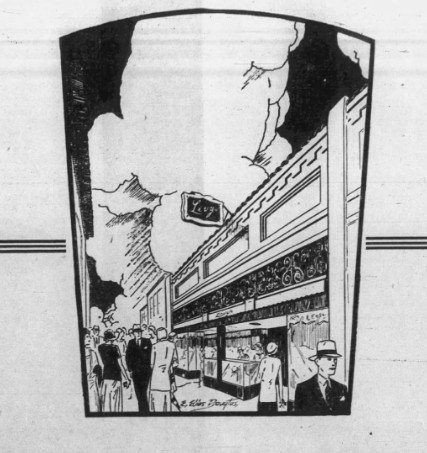
Jacob convinced Ben to quit the railroad and join him, at which time the store’s name changed to Levy Brothers Dry Goods Company. Levys Brothers, as it was more commonly known, continued to flourish, opening additional stores in Douglas and Bisbee, Arizona. In 1931, the Levy brothers opened their first location in Tucson. They acquired the Meyers and Bloom Men’s store on the corner of Congress and Scott in downtown Tucson, renaming the store Levy’s. On the eve of the store’s opening, an article in the Tucson Daily Citizen newspaper heralded the event as, “Part of the fruition of years of toil, honest and square dealing and adhering at all times to the slogan, ‘please your customer.’”5
And please the customer, they did. As with their three other locations in southern Arizona, the Levy brothers made the Tucson store a smashing success. Levy’s established itself as a store that provided quality goods and service at a fair price. In 1935, the Levy brothers divided their business interests. Ben took over the Southern Arizona stores, while Jacob and his sons, Aaron and Leon, assumed ownership of the Levy’s store in Tucson. When Jacob Levy passed away in 1946, his eldest son, Aaron, succeeded him as President.6
The 1950 Grand Opening: Scaling the Customer Experience
News of a new Levy’s store emerged in 1949, when a groundbreaking was announced for a new building on Pennington and Scott streets in downtown Tucson. At a cost of more than $2 million, the new department store boasted three levels, a basement, a 125-car capacity parking lot, and 54,000 square feet of floor space. The sleek, concrete building exterior, with its 27 display windows, introduced a modern flair to downtown Tucson. The Pennington building opened for business at noon on February 1, 1950. A throng of eager shoppers entered the department store with looks of “wonder and surprise and sometimes puzzlement on their faces.”7 Two and a half minutes after the doors opened, University of Arizona student Janet Wood made the first sale. The 18-year-old Wood purchased a jar of Helena Rubinstein Plus cleanser for $1.25. Moments later, in a gesture typifying Levy’s commitment to customer service, Wood received a $25 gift certificate for logging the first sale.8
Edward Fillmer: The Face of Accountability
Levy’s earned a reputation for outstanding customer service thanks to gestures like these, inspired by the owners and dedicated behind-the-scenes heroes such as Edward Fillmer. When Levy’s opened its third location at El Con Mall in November 1960, Fillmer had been working for months to ensure that the staff was up-to-snuff in the customer service department. Fillmer was a customer service pro, as the Arizona Daily Star noted in an article celebrating the store’s grand opening:
When a Levy’s customer has a problem, the man to see is Edward L. Fillmer. When a Levy’s employee has a problem, the man to see is Edward L. Fillmer. As credit manager, Fillmer prides himself on never letting a customer leave his office dissatisfied. As personnel manager, Fillmer says his office door is always open to all Levy’s employees. Whichever hat he wears, the bespectacled, blue-eyed West Virginia native shows all the charm and warmth of a born Southerner when dealing with people.9
To ensure a good customer experience, Fillmer developed a pre-opening training course. Every store employee participated in Fillmer’s one-week training program in courtesy, friendliness, and deportment. New employees also met with Fillmer in his office to learn about Levy’s history, store policies, and how to fill out a sales slip. “The El Con Branch may be new, but Levy’s has a 57-year reputation to maintain,”10 said Fillmer. In addition to training, Fillmer played a pivotal role in hiring new store employees. Fillmer and his assistants interviewed hundreds of people, hand-selecting those with the best personality, personal appearance, and experience in the department for which they were chosen. “Levy’s is proud of its services, and we have taken pains to have friendly and capable people at the El Con Branch service desks.”11
A Lesson for Modern Leadership
Now think back to that bill sitting on the TV stand. Imagine calling to contest that bill and being greeted by a courteous, well-trained staff member who is eager to assist you: No time-wasting announcements, confusing phone tree mazes, or long hold times. Just call a number, speak with a representative, and resolve the issue. There was a time when things were like this. There were companies, like Levy’s, that prided themselves on giving good customer service. Despite our technological advances, customer service has taken a major step back in the Digital Age. Too many companies prioritize profits and efficiency over customer satisfaction. I’m not naive enough to think this will change any time soon, but I can confidently say that, as a loyal customer, I reward companies that provide good customer service. It’s why I have stayed with American Express for over twenty years.
For the companies that do it the wrong way, here is my advice. To ensure employees knew where things were, Edward Fillmer had each department member at the new El Con store practice stocking the shelves themselves so they could identify the location of the merchandise.12 If a modern company chooses to cut corners on customer service, every member of the leadership, from the CEO to the Board of Directors, should spend time calling the customer service line to experience the maze of confusion and frustration they are putting their customers through. Take a cue from stores like Levy’s and do better by your customers.
Footnotes
1History of levy’s reveals by-gone era of the old west. (1969, September 15). Tucson Citizen, p. 2.
2Ibid.
3Ibid.
4Ibid.
5Levy’s will formally open their new store tonight. (1931, September 15). Tucson Daily Citizen, p. 8.
6Arizona Historical Society, MS 1271, Leon Levy Collection.
7Collier, J. (1950, February 2). Store with the new look surprises first buyer. Tucson Daily Citizen, p. 14.
8Ibid.
9The man to see is edward fillmer. (1960, November 16). Arizona Daily Star, p. 6.
10Ibid.
11Ibid.
12Ibid.